Volume Solutions to Snub Dodecahedron
See https://en.wikipedia.org/wiki/Snub_dodecahedron and the linked notebook at the bottom.
Abstract
Volume solutions to the Snub Dodecahedron, Thirteenth Archimedean Solid, are made by HSM Coxeter, EW Weisstein, MT Kosters, HC Rajpoot, and MS Adams. There are more than one closed form solution, each yielding different expressions. The Adams solution may possess discovery of an origin to one third powers of the golden ratio.
Keywords: Snub dodecahedron · Archimedean solids · Golden ratio
Mathematics Subject Classification (2000): 51M15, (51M20)
Contents
Closed form volume of the Snub Dodecahedron
Harold S. M. Coxeter
Eric W. Weisstein
Menno T. Kosters
Harish C. Rajpoot
Numerical
Mark S. Adams
Origin to one third powers of the golden ratio
References
Closed form volume of the Snub Dodecahedron
There are at least three closed form expressions for the volume of a snub dodecahedron of unit edge length:
Harold S. M. Coxeter
One of the world's finest and most eloquent geometers Harold Scott MacDonald Coxeter in his "Uniform Polyhedra."1. Uniform Polyhedra, Section 10, The Snub Polyhedra: We construct p q r by regarding the spherical triangles (p q r) as being alternately white and black (see § 3, especially figure 6). The three white triangles that surround a black one contain corresponding points forming an equilateral triangle which we may called a ‘snub face' of pqr. One of these three white triangles is derived from another, sharing with it the vertex P (say), by a rotation through about P. If this rotation takes the chosen point in the first triangle to in the second, we have an isosceles triangle whose base (opposite to the angle at P) is one side of the snub face. Solving this isosceles triangle, we find. Besides the usual twelve pentagrams and sixty 'snub’ triangles, they have each forty more triangles, lying by pairs in twenty planes (the face-planes of an icosahedron).
Eric W. Weisstein
MathWorld--A Wolfram Web Resource by Eric W. Weisstein shows in "Snub Dodecahedron."2 Coxeter's polynomial expression, volume is the real root of x:
$$187445810737515625 - 182124351550575000\,x^2 + 6152923794150000\,x^4 + 1030526618040000\,x^6 + \\ 162223191936000\,x^8 - 3195335070720\,x^{10} + 2176782336\,x^{12} = 0 \\$$Menno T. Kosters
The snub dodecahedron
In this SageMath notebook we will derive coordinates for the snub dodecahedron. We will start with a regular icosahedron, for which standard coordinates are well known. Then we will inscribe a snub dodecahedron in it. We will use the coordinates to obtain symbolic expressions and numeric values of various metric properties of the snub dodecahedron.
The icosahedron
The number is called the golden ratio. It satisfies . It plays an important role in the decription of the regular icosahedron. Indeed, the 12 points , and are the vertices of a regular icosahedron with edge length , centered at the origin. We want to do some symbolic computations with the number :
Let , , and be three vertices, forming one of the triangular faces of the icosahedron:
Let be the rotation sending to , to , and back to :
Now let be a point inside the triangle . Note that , because the - and - coordinates of , and satisfy this relation and lies in the plane through these three points.
Let be obtained from by applying , and let be the point .
We want to choose and so that is an equilateral triangle. Then , and will be vertices of a snub dodecahedron centered at the origin. The other vertices can then be found by applying the 60 rotational symmetries of the icosahedron. For this, the dot products , and need to be equal. Because this can be simplified to , or and :
(The right-hand side of our equations will always be , so we omit them.)
These two equations are simple to solve. Adding them removes the part:
This is linear in , so we now we can express in :
Substituting in eq2, and multiplying by to get rid of the denominator:
We now have an equation for alone. is clearly not the zero we want. It corresponds to the degenerate solution where , and . So, finally, we find that is a zero of the following polynomial:
Let be a zero of this polynomial. For the time being we do not specify which of the three zeroes.
Metric properties
We now want to use the coordinates we found to get symbolic expressions for lengths, volumes, etcetera. To this end we need to be able to do symbolic computations with :
We express the coordinates of in and :
Now we can compute the squared circumradius of our snub dodecahedron:
The edge length, squared:
As a volume, the snub dodecahedron can be seen as consisting of triangular pyramids and pentagonal pyramids, with apex at the origin . The volume of one triangular pyramid:
To handle the pentagonal pyramids we need an additional vertex of the icosahedron we started with: . will be the rotation around the axis taking to and to (and fixing ):
The volume of one pentagonal pyramid:
The total volume is equal to
If we want the volume of a snub dodecahedron with unit edge length we have to divide by the cube of the edge length. We first divide by the edge length squared:
This, together with the expression for the edge length, gives the following fairly simple formula for the volume of a snub dodecahedron of unit edge length:
The snub dodecahedron has two inscribed spheres: one touching the triangular faces, and one, slightly smaller, touching the pentagonal faces. We can compute the squares of their radii, by first computing the centers and of a triangular and pentagonal face:
This is not surprising: it is the squared inradius of the icosahedron we started with.
We can also compute the (cosine of) the angle between adjacent triangular faces. Let be the center of the triangle . Then the cosine of the angle between the vectors and equals , because . So for the angle between the faces and (with normals and ) we have:
Similarly, (the square of the cosine of) the angle between a triangular and an adjacent pentagonal face:
Numerical values
We now do all the preceding computations once again, this time not symbolically but numerically. From now on, will be the real number satisfying . We start by getting numerical values for and :
Edge length:
For the numerical results it seems more natural to have an edge length equal to . For the remainder of this section we will therefore divide lengths by , areas by and volumes by .
The circumradius:
The volume of one triangular pyramid:
The volume of one pentagonal pyramid:
The total volume:
The triangular faces inradius:
The pentagonal faces inradius:
The triangle-triangle dihedral angle (degrees):
The triangle-pentagon dihedral angle (degrees:)
We can show that the Adams and Kosters expressions are equal.
From Adams solution, :
It satisfies :
Now write Adams expression as (write ):
Now put and :
Now :
Now Adams expression can be written as
Computing the numerator of this expression shows that Adams expression is indeed equal to Kosters expression:
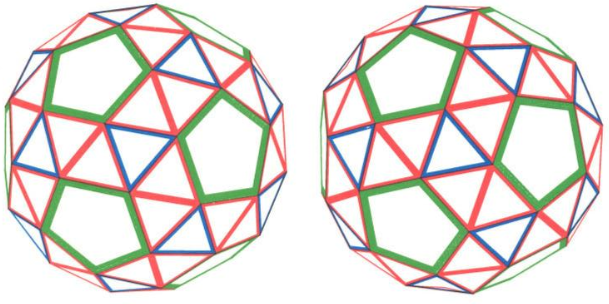
Harish C. Rajpoot
Harish Chandra Rajpoot published “Optimum Solution of Snub Dodecahedron"3 HCR's Theory of Polygon & Newton-Raphson Method is used to calculate the volume of the Snub Dodecahedron. After only 7 iterations, the calculated volume matches the closed-form solutions to 50 digits of accuracy.
Numerical
Jupyter notebook Snub Dodecahedron Volume Calculated Six Ways4 is a supplement to this essay. Six Python classes, each calculating the volume of the Snub Dodecahedron in a different way, the five methods above plus a 3D Numerical method. 3D distances drive a numerical root finder. Two triangle objects are defined as adjacent triangles on a regular icosahedron. The algorithm is applied to one point on the plane of each triangle so that the distance of a side of an inscribed snub triangle is equal to the side of a non inscribed snub triangle.
Mark S. Adams
Mark Shelby Adams published "Archimedean Platonic Solids"7. Whereas Kosters' solution inscribes a Snub Dodecahedron on to a regular icosahedron with an edge length of , Adams' solution inscribes a Snub Dodecahedron on to a regular icosahedron with an edge length of .

ParseError: KaTeX parse error: Invalid color: 'blue ' at position 376: …overline{\color{̲b̲l̲u̲e̲ ̲}̲{a}\color{green…
ParseError: KaTeX parse error: Invalid color: 'blue ' at position 377: …}{b}} } \color{̲b̲l̲u̲e̲ ̲}̲{)^2} \,+\, \c…
ParseError: KaTeX parse error: Invalid color: 'blue ' at position 377: …overline{\color{̲b̲l̲u̲e̲ ̲}̲{a}\color{green…
Origin to one third powers of the Golden Ratio
Spinnability of the First Golden Circle leads to a new second root, if a is taken as , the alternate root:
Golden Ratio powers may be expressed as the sum of two Fibonacci Sequences (r,s):
The oscillation of may be extended to One third powers of the Golden Ratio.
Vectors are used to plot the alternate root as the Origin to One third powers of the Golden Ratio.

References
[1] Coxeter, Harold S. M.; Longuet-Higgins, M. S.; and Miller, J. C. P. "Uniform Polyhedra." Phil. Trans. Roy. Soc. London, 1954.
[2] Weisstein, Eric W. MathWorld--A Wolfram Web Resource Snub Dodecahedron.
[3] Rajpoot, Harish C. “Optimum Solution of Snub Dodecahedron" 2014.
[4] Snub Dodecahedron Volume Calculated Six Ways, Golden_Powers_Plot supplements to this essay.
[5] Wikipedia Snub Dodecahedron.
[6] Sage Math Library of polytopes_Snub_Dodecahedron.
[7] Adams, Mark S. "Archimedean Platonic Solids" 1985.
CITE THIS ESSAY AS:
Adams, Mark S.; Kosters, Menno T. Volume_Solutions_To_Snub_Dodecahedron 2021.
Mark S. Adams
ORCID iD 0000-0003-4469-051X