
<type 'sage.matrix.matrix_integer_dense.Matrix_integer_dense'>
[(4.0, [(-0.7071067811865475, -0.7071067811865475)], 1), (6.0, [(-0.3162277660168379, -0.9486832980505138)], 1)]
[ 0.57 0.5025]
[ 0.33 0.917]
[(0.3008632979519208, [(-0.8815235799988788, 0.4721399982059986)], 1), (1.186136702048079, [(-0.6320226312996823, -0.7749499296890257)], 1)]
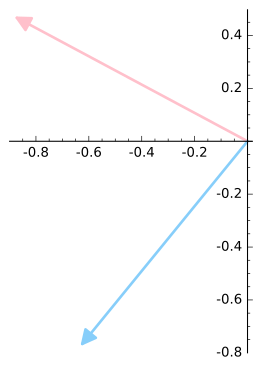
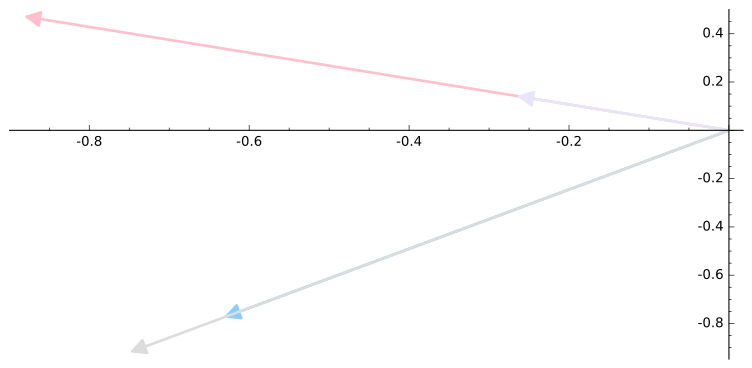
'Norms in order of e1, e2, e3, e4'
1.00035393736417
1.00002449969988
0.30103014017868707
1.1861742448861592
'Ratios of new vector over old vector in order e3/e1 and e4/e2'
0.30092363206153844
1.1861451846851174
[(0.3008632979519208, [(-0.8815235799988788, 0.4721399982059986)], 1), (1.186136702048079, [(-0.6320226312996823, -0.7749499296890257)], 1)]
0.30092363206153844
1.1861451846851174
'The eigenvalues corresponding to the eigenvectors are the same when found from code and when computed from the ratios.'
[ 0.0 0.0 35315.0]
[ 3e-05 0.777 0.0]
[ 0.0 0.071 0.949]
'1. The average adult produces .35315 larvae per month.'
'2. .949 of the total adults survive month to month.'
'3. .00003 of the total larvae survive to become juveniles per month.'
'4. .777 of the total juveniles will still be juveniles in the following month.'
[ 0.0 0.0 35315.0]
[ 3e-05 0.777 0.0]
[ 0.0 0.071 0.949]
[0.15026156162015658, 0.44126018150798385, 1.1344782568718599]
'The dominant eigenvalue is .00000102, meaning the lionfish population will decrease over time.'
(1.05945000000000e6, 38.8506000000000, 32.0200000000000)
(0.001165518, 32.4603362, 37414476780.38698)
[0.15026156162015658, 0.44126018150798385, 1.1344782568718599]
[(0.15026156162015658, [(0.9999999988453299, -4.78668582110772e-05, 4.254893429043022e-06)], 1), (0.44126018150798385, [(-0.9999999959297882, 8.935490586919178e-05, -1.2494978895992127e-05)], 1), (1.1344782568718599, [(0.9999999959626241, 8.392118765878536e-05, 3.212454346004658e-05)], 1)]
'Go from here'
(0.001165518, 32.4603362, 37414476780.38698)
population grows
population grows
population grows
'For initial conditions larvae=20, juveniles=50, adults=30, the long-term behavior is that they all grow.'
(1.05945000000000e6, 38.8506000000000, 32.0200000000000)
(0.001165518, 32.4603362, 37414476780.38698)
[0.15026156162015658, 0.44126018150798385, 1.1344782568718599]
[(0.15026156162015658, [(0.9999999988453299, -4.78668582110772e-05, 4.254893429043022e-06)], 1), (0.44126018150798385, [(-0.9999999959297882, 8.935490586919178e-05, -1.2494978895992127e-05)], 1), (1.1344782568718599, [(0.9999999959626241, 8.392118765878536e-05, 3.212454346004658e-05)], 1)]
3D rendering not yet implemented
3D rendering not yet implemented
3D rendering not yet implemented
'For initial conditions larvae=20, juveniles=50, adults=30, the long-term behavior is that they all grow.'
population grows
population grows
population grows
0.999947270121769
0.0000236938463467597
0.0000290360318844538
0.999958421249606
0.0000134760678619528
0.0000281026825317845
'For the first set of initial conditions, the longterm proportions are .99995 larvae, .00002 juveniles, and .00003 adults.'
'For the second set of initial conditions, the longterm proportions are .99996 larvae, .00001 juveniles, and .00003 adults.'
'For a population to be constant or declining, the dominant eigenvalue has to be equal to or less than one, respectively.'
'The three methods I will try are reducing the number of lionfish larvae laid; reducing the number of larvae that survive to be juveniles; and reducing the number of juveniles that survive to be adults.'
0.999926584658958
0.0000237946092323904
0.0000496207318095854
'The larvae growth rate goes from .9999584 to .9999266 so it is a small degree of change. The juvenile growth rate goes from .00001348 to .00001348 which is not a significant change at all. The adult growth rate goes from .0000281 to .0000277 which is also a small degree of change. The change with the most significant results is the alteration of the number of larvae born, which makes sense because a birthrate lower than whatever the threshhold for maintaining the species population will definitely lead to decline.'