
Trim Rowmotion and Independence Posets Code
unlisted
ubuntu2004-eol%auto ############################################################## # INITIALIZE THIS CELL ############################################################## from sage.graphs.independent_sets import IndependentSets from sage.combinat.cyclic_sieving_phenomenon import * ############################################################## # code for maximal orthogonal pairs ############################################################## def inc(a,b): if a[0].issubset(b[0]) and a[1].issubset(b[1]): return True else: return False def inc1(a,b): if a[0].issubset(b[0]): return True else: return False def mops(g): sets=[] edges=[(i[0],i[1]) for i in g.edges()] for s in Subsets(g): for t in Subsets(Set(g).difference(s)): no=False for i in s: for j in t: if (i,j) in edges: no=True break if no==True: break if no==False: sets.append((s,t)) P=Poset([sets,inc]) Pmax=P.maximal_elements() return Pmax def poset_of_mops(g): #naively, and slowly, computes the poset of maximal orthogonal pairs from the directed graph g return Poset([mops(g),inc1]) def complete_mop(g,s): #naively, and slowly, computes the ways to complete s to a maximal orthogonal pair sets=[] edges=[(i[0],i[1]) for i in g.edges()] for t in Subsets(Set(g).difference(s)): no=False for i in s: for j in t: if (i,j) in edges: no=True break if no==True: break if no==False: sets.append((s,t)) P=Poset([sets,inc]) return P.maximal_elements() ############################################################## # code for left modular lattices ############################################################## def is_left_modular(L,H=False,verbose=False): #checks if the subset of elements H of the lattice L is left modular; if verbose=True, then gives a list of failures if H==False: H=L for x in H: for z in L: for y in L.principal_lower_set(z): if (L.join(y, L.meet(x, z)) != L.meet(L.join(y, x), z)): if verbose==False: return False else: out+=[(y,x,z)] if verbose==False: return True else: return out def join_irr_label(L,c,j): #given a left modular lattice L, a left modular chain c, and a join-irreducible element, returns the corresponding label for i in range(len(c)): if L.le(j,c[i]): return i def meet_irr_label(L,c,m): #given a left modular lattice L, a left modular chain c, and a meet-irreducible element, returns the corresponding label for i in range(len(c)-1,-1,-1): #print (m,c[i]) if L.ge(m,c[i]): return i+1 def downward_labels(L,c,z): #given a trim lattice L, a left modular chain c, and an element z, returns the downward labels for z J=L.join_irreducibles() JL=dict([(j,join_irr_label(L,c,j)) for j in J]) cov=L.lower_covers(z) return [min([JL[j] for j in J if L.join([y,j])==z]) for y in cov] def upward_labels(L,c,z): #given a trim lattice L, a left modular chain c, and an element z, returns the upward labels for z M=L.meet_irreducibles() ML=dict([(m,meet_irr_label(L,c,m)) for m in M]) cov=L.upper_covers(z) return [max([ML[m] for m in M if L.meet([y,m])==z]) for y in cov] def cover_label(L,c,edge): #given a trim lattice L, a left modular chain c, and a covering relation, returns the label for that relation return min([JL[j] for j in J if L.join([edge[0],j])==edge[1]]) ############################################################## # trim lattices ############################################################## def is_trim(L): #checks if the lattice L is trim; computes all maximal length chains of L, which can take a while. If it is true, it returns a (True,list of maximal chains) J=L.join_irreducibles() M=L.meet_irreducibles() C=L.maximal_chains() n=max(map(len,C)) #print n,len(J),len(M) mC=[c for c in C if len(c)==n] #print is_left_modular(mC[0]) if len(J)==len(M) and len(J)==n-1 and is_left_modular(L,mC[0]): return (True,mC) else: return (False,False) #def trim_rowmotion(L,c): # Ple=P.linear_extension() # def cyc_act(d): # return tuple(togud_seq(d,Ple)) # map(len,orbit_decomposition(L,cyc_act)) #def is_sub(a,b): # return a.issubset(b) #def noncrossing_lattice(L): #returns the noncrossing partition lattice for the lattice L represented as mops; in general, we only expect this to have nice properties when L is a twisted Cambrian lattice # N=[] # for i in L: # N+=[i[0].intersection(trim_rowmotion(L,i)[1])] # return Poset([N,is_sub]) ############################################################## # tight repellent independent pairs ############################################################## def complete_trip(G,u): #given an independent set u in the digraph G, return the trip of the form (J,u) m=Set([]) H=DiGraph(G) H.reverse_edges(H.edges()) P=Poset(G) Q=Poset(H) m=Set([]) for k in P.linear_extension(): if Set([i[1] for i in H.edges_incident(k)]).intersection(m)==Set([]) and Set([i[1] for i in G.edges_incident(k)]).intersection(u)==Set([]) and k not in u: m=m.union(Set([k])) return (m,u) def trip_to_mop(G,du): #computes the mop corresponding to a trip pass def maximal_trip(G): #given a directed graph G, return the maximal trip of the form (J,[]) return complete_trip(G,Set([])) def minimal_trip(G): #given a directed graph G, return the minimal trip of the form ([],M) H=DiGraph(G) H.reverse_edges(H.edges()) P=Poset(G) Q=Poset(H) m=Set([]) for k in Q.linear_extension(): if Set([i[1] for i in G.edges_incident(k)]).intersection(m)==Set([]): m=m.union(Set([k])) return (Set([]),m) def flip_up(G,du,j): #given a directed graph G, a trip (D,U) and an element j in u, return flip_j(D,U) a=du[0] b=du[1] if j not in b: return du elif j in b: return flip(G,du,j) def flip(G,du,j): #given a directed graph G, a trip (D,U) and an element j of G, return flip_j(D,U) H=DiGraph(G) H.reverse_edges(H.edges()) P=Poset(G) Q=Poset(H) a=du[0] b=du[1] if j not in b and j not in a: return du elif j in b: a2=Set([k for k in a if not(Q.le(k,j))]+[j]) b2=Set([k for k in b if not(Q.ge(k,j))]) elif j in a: a2=Set([k for k in a if not(Q.le(k,j))]) b2=Set([k for k in b if not(Q.ge(k,j))]+[j]) #print "first step: ",(a2,b2) for k in P.linear_extension(): if not(Q.ge(k,j)) and Set([i[1] for i in G.edges_incident(k)]).intersection(b)==Set([]) and Set([i[1] for i in H.edges_incident(k)]).intersection(a2)==Set([]) and (k not in b2): a2=a2.union(Set([k])) for k in Q.linear_extension(): if not(Q.le(k,j)) and Set([i[1] for i in H.edges_incident(k)]).intersection(a)==Set([]) and Set([i[1] for i in G.edges_incident(k)]).intersection(b2)==Set([]) and (k not in a2): b2=b2.union(Set([k])) return (a2,b2) def flips(G,du,s): #given a directed graph G, a trip (D,U) and a sequence s of elements j of G, return (\prod_{j \in s} flip_j)(D,U) dv=tuple(du) for i in s: dv=flip(G,dv,i) return dv def make_flip_poset(G): #given a directed graph G, return the corresponding independence poset edges=[] els=Set([]) last=[] new=[minimal_trip(G)] while new!=[]: last=new els=els.union(Set(last)) new=[] for a in last: for i in a[1]: b=flip(G,a,i) edges.append([a,b]) if b not in new: new=new+[b] return Poset((list(els),edges)) def make_flip_tree(G): #given a directed graph G, return the corresponding flip tree edges=[] els=Set([]) last=[] new=[(min_ind(),-1)] while new!=[]: last=new els=els.union(Set(last)) new=[] for a in last: for i in a[0][1]: j=Q.linear_extension().index(i) if a[1]==-1 or j>a[1]: b=tog(a[0],i) edges.append([a,(b,j)]) if b not in new: new=new+[(b,j)] return Poset((list(els),edges)) def rowmotion(L,x): #compute rowmotion on the trip x lower=dict([(l,l[0]) for l in L]) upper=dict([(l[1],l) for l in L]) return upper[lower[x]] def tog(G,x): H=G for i in H.edges(): if x in i: H.reverse_edge(i) return(H) #ed=G.edges_incident(x) #return G.reverse_edges(ed,inplace=False) ############################################################## # Galois graphs ############################################################## def semidistributive_Galois_graph(L): #returns the Galois graph for a semidistributive lattice L lower=dict([(l,Set(L.canonical_joinands(l))) for l in L]) J=L.join_irreducibles() M=L.meet_irreducibles() meet_to_join=dict([(m,L.meet([l for l in J if L.le(l,L.upper_covers(m)[0]) and not(L.le(l,m))])) for m in M]) upper=dict([(Set([meet_to_join[i] for i in L.canonical_meetands(l)]),l) for l in L]) return DiGraph([ [j for j in J] ,[(j,meet_to_join[m]) for j in J for m in M if j!=meet_to_join[m] and not(L.le(j,m))]]) def trim_Galois_graph(L,c): #returns the Galois graph for a trim lattice L, using the chain c J=L.join_irreducibles() M=L.meet_irreducibles() JL=dict([(j,join_irr_label(L,c,j)) for j in J]) lower=dict([(l,Set(downward_labels(L,c,l))) for l in L]) return DiGraph([ [join_irr_label(L,c,j) for j in J] ,[(join_irr_label(L,c,j),meet_irr_label(L,c,m)) for j in J for m in M if join_irr_label(L,c,j)!=meet_irr_label(L,c,m) and not(L.le(j,m))]]) def Weyl_word_Galois_graph(W,w): #returns the Galois graph for the word w in the Weyl group W; when w is the c-sorting word for w_o, this is the Galois graph for the Cambrian lattice edges=[] for i in range(len(w)): r=[t.reflection_to_root() for t in W.inversion_sequence(w[i:])] for j in range(1,len(r)): if (r[j]-r[0]).is_positive_root():# or (r[j]-r[0])==0: edges.append([j+i,i]) return DiGraph(edges) def Cambrian_Galois_graph(W,c): return Weyl_word_Galois_graph(W,W.w0.coxeter_sorting_word(c)) def twisted_Galois_graph(W,c,v): w=v.inverse() #Galois graph for twisted Cambrian; here w is c-sortable with w \geq c in weak order (i.e. ``positive'') G0=Weyl_word_Galois_graph(W,W.w0.coxeter_sorting_word(c)) wr=W.inversion_sequence(W.w0.coxeter_sorting_word(c)) wc=[wr.index(i) if i in wr else -1 for i in W.inversion_sequence(list(c)+W.w0.coxeter_sorting_word(c))] #print wc for i,j in enumerate(wc): if wc.index(j)!=i: wc[i]=False wc=wc[len(c):] #print wc s=Set([wr.index(i) for i in w.inversions()]) #print s x=complete_mop(G0,s)[0] #print x ed=[(i[0],i[1]) for i in G0.edges()] #if Set(range(len(c))).issubset(x[0]): G1=G0.subgraph(x[0]) G2=G0.subgraph(x[1]) G=G1.union(G2) for g2 in G2: for g1 in G1: if wc[g1]!=False and ((g2,wc[g1]) in ed or g2==wc[g1]): G.add_edge(g1,g2) return G #else: # return False ############################################################## # Cambrian lattices ############################################################## def cambrian_intervals(W,c): #returns all Cambrian intervals in the Cambrian lattice for W,c WW=W.weak_lattice(facade=True) sort=[w for w in W if w.is_coxeter_sortable(c)] intervals=dict([]) for w in W: t=WW.subposet([s for s in sort if s.weak_le(w)]).maximal_elements()[0] if t in intervals: intervals[t]=intervals[t]+(w,) else: intervals[t]=(w,) return intervals def Cambrian_lattice(W,c): return LatticePoset(make_flip_poset(Cambrian_Galois_graph(W,c))) def twisted_Cambrian_lattice(W,c,w): #returns the twisted Cambrian; here w is c-sortable with w \geq c in weak order (i.e. ``positive'') return make_flip_poset(twisted_Galois_graph(W,c,w)) def uniq(input): output = [] for x in input: if x not in output: output.append(x) return output
# Builds an example of the independence poset for the directed graph on [a]x[b]
# This can take a long time if you increase a or b
a=2
b=3
G=DiGraph([[(i,j) for i in range(a) for j in range(b)],[[(i,j),(i+1,j)] for i in range(a-1) for j in range(b)]+[[(i,j),(i,j+1)] for i in range(a) for j in range(b-1)]])
#view(G)
IndPoset=make_flip_poset(G)
IndPoset.show() # show the independence poset (note that arrows point towards *larger* elements with Sage conventions)

# Shows an example of a flip on the maximal element of the independence poset IndPoset
# (which must contain the soures of the digraph G)
p_max=IndPoset.maximal_elements()[0]
print "p_max =",p_max
print "flip_g(p_max) at a source g =",flip(G,p_max,G.sources()[0]),"\n"

# Shows an example of a flip on the minimal element of the independence poset IndPoset
# (which must contain the sinks of the digraph G)
p_min=IndPoset.minimal_elements()[0]
print "p_min =",p_min
print "flip_g(p_min) at a sink g =",flip(G,p_min,G.sinks()[0])
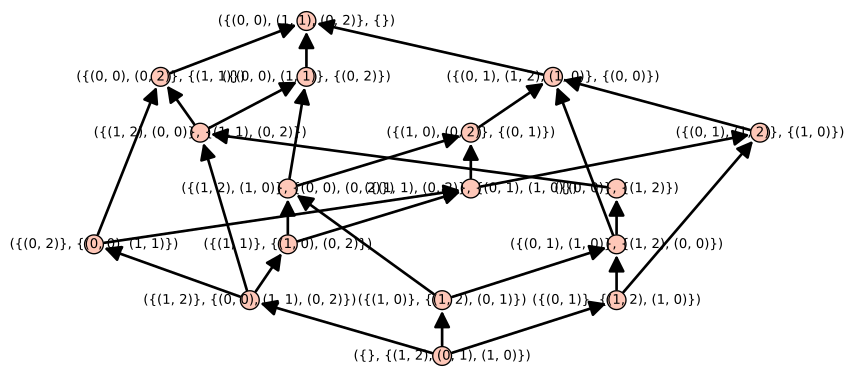
p_max = ({(0, 0), (1, 1), (0, 2)}, {})
flip_g(p_max) at a source g = ({(0, 1), (1, 2), (1, 0)}, {(0, 0)})
p_min = ({}, {(1, 2), (0, 1), (1, 0)})
flip_g(p_min) at a sink g = ({(1, 2)}, {(0, 0), (1, 1), (0, 2)})
# Examples: Building posets of maximal orthogonal pairs (mops) and tight orthogonal pairs (tops)
# These posets are isomorphic iff the top poset is a trim lattice iff the top poset is a lattice

G=DiGraph([[0,1],[1,2]])
M=poset_of_mops(G) # make the lattice of maximal orthogonal pairs corresponding to G
F=make_flip_poset(G) # make the poset of tight orthogonal pairs coresponding to G
print "Posets of mops and tops are isomorphic?",M.is_isomorphic(F)
print "Poset of tops is a lattice?",F.is_lattice()
print "The maximal length of a chain in the poset of mops is",max(map(len,M.maximal_chains()))
print "The maximal length of at chain in the poset of tops is",max(map(len,F.maximal_chains()))
print "The rowmotion orbits on the poset of tops have lengths",map(len,orbit_decomposition(F,lambda x: rowmotion(F,x)))
print "\n"

G=DiGraph([[0,1],[1,2],[2,3]])
M=poset_of_mops(G) # make the lattice of maximal orthogonal pairs corresponding to G
F=make_flip_poset(G) # make the poset of tight orthogonal pairs coresponding to G
print "Posets of mops and tops are isomorphic?",M.is_isomorphic(F)
print "Poset of tops is a lattice?",F.is_lattice()
print "The maximal length of a chain in the poset of mops is",max(map(len,M.maximal_chains()))
print "The maximal length of at chain in the poset of tops is",max(map(len,F.maximal_chains()))
print "The rowmotion orbits on the poset of tops have lengths",map(len,orbit_decomposition(F,lambda x: rowmotion(F,x)))
print "\n"

G=DiGraph([[0,1],[1,2],[2,3],[3,4]])
M=poset_of_mops(G) # make the lattice of maximal orthogonal pairs corresponding to G
F=make_flip_poset(G) # make the poset of tight orthogonal pairs coresponding to G
print "Posets of mops and tops are isomorphic?",M.is_isomorphic(F)
print "Poset of tops is a lattice?",F.is_lattice()
print "The maximal length of a chain in the poset of mops is",max(map(len,M.maximal_chains()))
print "The maximal length of at chain in the poset of tops is",max(map(len,F.maximal_chains()))
print "The rowmotion orbits on the poset of tops have lengths",map(len,orbit_decomposition(F,lambda x: rowmotion(F,x)))
print "\n"

G=DiGraph([[0,1],[1,2],[2,3],[3,4],[4,5]])
M=poset_of_mops(G) # make the lattice of maximal orthogonal pairs corresponding to G
F=make_flip_poset(G) # make the poset of tight orthogonal pairs coresponding to G
print "Posets of mops and tops are isomorphic?",M.is_isomorphic(F)
print "Poset of tops is a lattice?",F.is_lattice()
print "The maximal length of a chain in the poset of mops is",max(map(len,M.maximal_chains()))
print "The maximal length of at chain in the poset of tops is",max(map(len,F.maximal_chains()))
print "The rowmotion orbits on the poset of tops have lengths",map(len,orbit_decomposition(F,lambda x: rowmotion(F,x)))
print "\n"
Posets of mops and tops are isomorphic? True
Poset of tops is a lattice? True
The maximal length of a chain in the poset of mops is 4
The maximal length of at chain in the poset of tops is 4
The rowmotion orbits on the poset of tops have lengths [3, 2]
Posets of mops and tops are isomorphic? False
Poset of tops is a lattice? False
The maximal length of a chain in the poset of mops is 5
The maximal length of at chain in the poset of tops is 5
The rowmotion orbits on the poset of tops have lengths [3, 5]
Posets of mops and tops are isomorphic? False
Poset of tops is a lattice? False
The maximal length of a chain in the poset of mops is 6
The maximal length of at chain in the poset of tops is 7
The rowmotion orbits on the poset of tops have lengths [8, 2, 3]
Posets of mops and tops are isomorphic? False
Poset of tops is a lattice? False
The maximal length of a chain in the poset of mops is 7
The maximal length of at chain in the poset of tops is 9
The rowmotion orbits on the poset of tops have lengths [11, 7, 3]
# Example: distributive lattices
P=Poset([[0,1],[[0,1],[0,2]]])
L=P.order_ideals_lattice()
trim=is_trim(L)
print "The distributive lattice L is trim: ",trim[0]
G=trim_Galois_graph(L,trim[1][0]) # compute a Galois graph from a trim lattice
G2=DiGraph([[1,0],[2,0]]) # constructing a new Galois graph G2
print "The Galois graph of L is isomorphic to a certain directed path: ",G.is_isomorphic(G2)
M=poset_of_mops(G) # make the lattice of maximal orthogonal pairs corresponding to G
F=make_flip_poset(G) # make the poset of tight orthogonal pairs coresponding to G
print "L is isomorphic to the lattice of maximal orthogonal sets: ",M.is_isomorphic(L)
print "L is isomorphic to the poset of tight orthogonal sets: ",F.is_isomorphic(L)
print "The rowmotion orbits on the poset of tops have lengths",map(len,orbit_decomposition(F,lambda x: rowmotion(F,x)))
The distributive lattice L is trim: True
The Galois graph of L is isomorphic to a certain directed path: True
L is isomorphic to the lattice of maximal orthogonal sets: True
L is isomorphic to the poset of tight orthogonal sets: True
The rowmotion orbits on the poset of tops have lengths [2, 3]
# Example: Cambrian lattices
W=WeylGroup(['A',2])
c=W.from_reduced_word([1,2])
L=W.m_cambrian_lattice(c,1).relabel()
trim=is_trim(L)
print "The Cambrian lattice L of type A_2 is trim: ",trim[0]
G=trim_Galois_graph(L,trim[1][0]) # compute a Galois graph from a trim lattice
G2=DiGraph([[0,1],[1,2]]) # constructing a new Galois graph G2
print "The Galois graph of L is a directed path: ",G.is_isomorphic(G2)
M=poset_of_mops(G) # make the lattice of maximal orthogonal pairs corresponding to G
F=make_flip_poset(G) # make the poset of tight orthogonal pairs coresponding to G
print "L is isomorphic to the lattice of maximal orthogonal sets: ",M.is_isomorphic(L)
print "L is isomorphic to the poset of tight orthogonal sets: ",F.is_isomorphic(L)
print "The rowmotion orbits on the poset of tops have lengths",map(len,orbit_decomposition(F,lambda x: rowmotion(F,x)))
The Cambrian lattice L of type A_2 is trim: True
The Galois graph of L is a directed path: True
L is isomorphic to the lattice of maximal orthogonal sets: True
L is isomorphic to the poset of tight orthogonal sets: True
The rowmotion orbits on the poset of tops have lengths [3, 2]