Book a Demo!
CoCalc Logo Icon
StoreFeaturesDocsShareSupportNewsAboutPoliciesSign UpSign In
Download

MATH 351 Project Syd Lynch

953 views
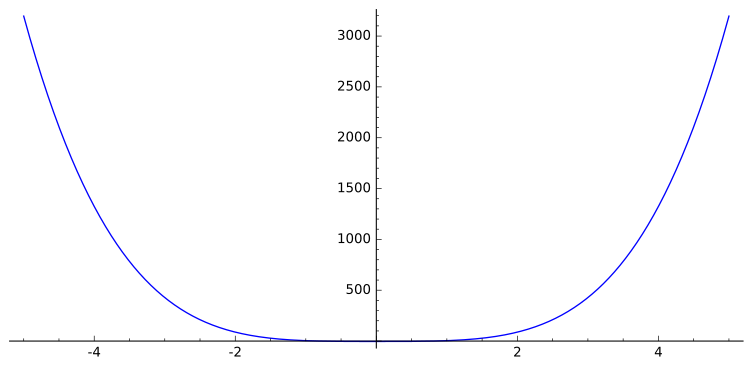
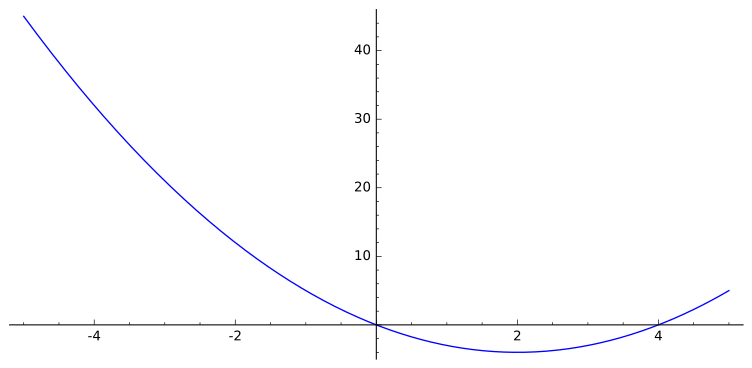
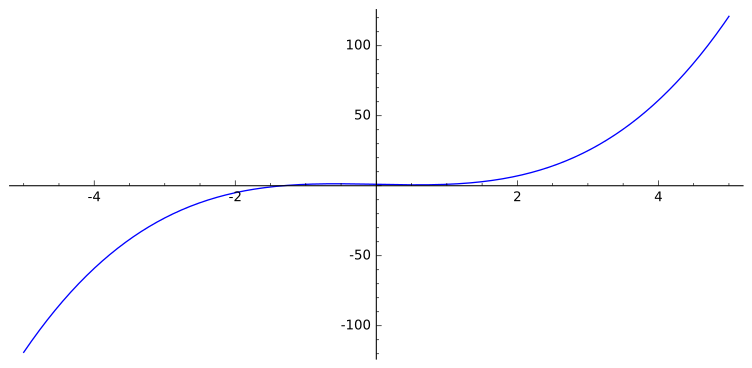
%md Syd Lynch MATH 351 Project Efficiency of Standard and Hybrid Root-Finding Methods Sources Used: http://cavern.uark.edu/~arnold/4363/HybridRoots.pdf http://blogs.mathworks.com/cleve/2015/10/12/zeroin-part-1-dekkers-algorithm/ https://math.berkeley.edu/~mgu/Seminar/Fall2011/7sept2011zerofinder.pdf http://www.karenkopecky.net/Teaching/eco613614/Notes_RootFindingMethods.pdf To explore the efficiency of various root-finding methods including those that are hybrid, I've programmed functions that correspond to the bisection method, the secant method, Newton's method, and the two seemingly most popular hybrid algorithms: Dekker's method and Brent's method. Using Python's time library, I calculated the amount of time each function took to compute various functions of x and included the number of iterations each while loop ran to find a root accurate to some number of decimal places. In addition, I compared the functions I wrote to those provided by SciPy's Optimize module which includes Brent's method, the bisection method, and Newton's method. I timed these as well, and there is a significant improvement in speed when using these functions as opposed to mine. This is seen especially when comparing my relatively inefficient Brent's method to brenth and brentq. Dekker's Method: This is one of the earliest examples of hybrid root-finding. It utilizes both the bisection method and the secant method, making use of the inherently faster secant method whenever its result is between the value of b and the midpoint. If the result of the secant method is not between these two values, then the bisection method is used. This is run in a loop that often performs both methods numerous times until an approximate root within a certain accuracy is found. Dekker's method can perform poorly if the passed in function causes the method to only use the secant method in small iterations rather than interchanging between the two. Brent's Method: Brent's is one of the fastest and most prevalent root-finding methods. Inspired by Dekker's method, Brent's used the secant and bisection methods, but also employs inverse quadratic interpolation and a large conditional check to determine the best method to use. The conditional check circumvents the potential issue in Dekker's method where only the secant method is used repeatedly for small iterations. SciPy's implementation of Brent's method includes brentq and brenth. The function brentq is the standard implementation of Brent's method using inverse quadratic interpolation, while brenth uses hyberbolic extrapolation. It is noted in the SciPy documentation that it performs on par with brentq, but has been tested less. Other hybrid methods for approximating roots exist. One example is called NewtSafe which implements both the bisection method and Newton's method and only performs Newton's if the approximate root is between a bound and the midpoint, otherwise it will compute the root using the bisection method. Regardless, Brent's method is considered to be the best hybrid method to compute roots. Plotting these functions below and using more reliable methods of finding roots, we can determine that there are approximate roots at: f(x) ~ 4 g(x) ~ -1.3 h(x) ~ 0.8
Syd Lynch MATH 351 Project Efficiency of Standard and Hybrid Root-Finding Methods Sources Used: http://cavern.uark.edu/~arnold/4363/HybridRoots.pdf http://blogs.mathworks.com/cleve/2015/10/12/zeroin-part-1-dekkers-algorithm/ https://math.berkeley.edu/~mgu/Seminar/Fall2011/7sept2011zerofinder.pdf http://www.karenkopecky.net/Teaching/eco613614/Notes_RootFindingMethods.pdf To explore the efficiency of various root-finding methods including those that are hybrid, I've programmed functions that correspond to the bisection method, the secant method, Newton's method, and the two seemingly most popular hybrid algorithms: Dekker's method and Brent's method. Using Python's time library, I calculated the amount of time each function took to compute various functions of x and included the number of iterations each while loop ran to find a root accurate to some number of decimal places. In addition, I compared the functions I wrote to those provided by SciPy's Optimize module which includes Brent's method, the bisection method, and Newton's method. I timed these as well, and there is a significant improvement in speed when using these functions as opposed to mine. This is seen especially when comparing my relatively inefficient Brent's method to brenth and brentq. Dekker's Method: This is one of the earliest examples of hybrid root-finding. It utilizes both the bisection method and the secant method, making use of the inherently faster secant method whenever its result is between the value of b and the midpoint. If the result of the secant method is not between these two values, then the bisection method is used. This is run in a loop that often performs both methods numerous times until an approximate root within a certain accuracy is found. Dekker's method can perform poorly if the passed in function causes the method to only use the secant method in small iterations rather than interchanging between the two. Brent's Method: Brent's is one of the fastest and most prevalent root-finding methods. Inspired by Dekker's method, Brent's used the secant and bisection methods, but also employs inverse quadratic interpolation and a large conditional check to determine the best method to use. The conditional check circumvents the potential issue in Dekker's method where only the secant method is used repeatedly for small iterations. SciPy's implementation of Brent's method includes brentq and brenth. The function brentq is the standard implementation of Brent's method using inverse quadratic interpolation, while brenth uses hyberbolic extrapolation. It is noted in the SciPy documentation that it performs on par with brentq, but has been tested less. Other hybrid methods for approximating roots exist. One example is called NewtSafe which implements both the bisection method and Newton's method and only performs Newton's if the approximate root is between a bound and the midpoint, otherwise it will compute the root using the bisection method. Regardless, Brent's method is considered to be the best hybrid method to compute roots. Plotting these functions below and using more reliable methods of finding roots, we can determine that there are approximate roots at: f(x) ~ 4 g(x) ~ -1.3 h(x) ~ 0.8
def g(x): return (x**3)-(x)+1 def h(x): return 5*x**4+3*x**2-4 def f(x): return x**2-4*x plot(f, -5, 5) plot(g, -5, 5) plot(h, -5, 5)
import time import scipy from scipy import optimize def bisectionMethod(f, a, b, accuracy): ''' Function that computes an approximate root for a given function using the bisection method. args: f: a function a: an initial guess for the range b: an intial guess for the range (An exception will be raised for invalid guesses of a and b) accuracy: desired tolerance output: a list that contains an approximate root c and the number of iterations required ''' count = 0 if f(a)*f(b) > 0: raise Exception("Invalid values for a and b, require sign change") while abs(b - a) > accuracy: c = (a+b)/2.0 if f(c) == 0: return c elif f(a)*f(c) > 0: a = c else: b = c count += 1 return [c, count] def secantMethod(f, a, b, accuracy): ''' Function that computes an approximate root for a given function using the secant method. args: f: a function a, b: an initial value, most efficient when close to the root accuracy: desired tolerance output: a list that contains an approximate root c and the number of iterations required ''' count = 0 while abs(b-a) > accuracy: c = ((a * f(b)) - (b * f(a))) / (f(b) - f(a)) a = b b = c count += 1; return [float(c), count]; def newtonsMethod(f, fp, xn, accuracy): ''' Function that computes an approximate root for a given function using Newton's method. args: f: a function fp: the derivative of f xn: an initial guess accuracy: desired tolerance output: a list containing an approximate root xn_1 and the number of iterations required ''' count = 0 xn_1 = xn - (f(xn)/fp(xn)) while abs(f(xn_1)) > accuracy: xn_1 = xn - (f(xn)/fp(xn)) xn = xn_1 count += 1 return [float(xn_1), count] def dekkersMethod(f, a, b, accuracy): ''' Code inspired by: http://cavern.uark.edu/~arnold/4363/HybridRoots.pdf http://blogs.mathworks.com/cleve/2015/10/12/zeroin-part-1-dekkers-algorithm/ https://math.berkeley.edu/~mgu/Seminar/Fall2011/7sept2011zerofinder.pdf Function that computes an approximate root for a given function using Dekker's method. args: f: a function a, b: an initial value, most efficient when close to the root iterations: number of times to run the loop accuracy: desired tolerance output: a list that contains an approximate root b and the number of iterations required ''' if f(a)*f(b) > 0: raise Exception("Invalid values for a and b, require sign change") fa = f(a) fb = f(b) # initialize our c to be a and f(a) c = a fc = fa count = 0 while abs(b-a) > accuracy: # Perform swaps to have properly inverted signs if fb*fc > 0: c = a fc = fa if abs(fc) < abs(fb): a = b fa = fb b = c fb = fc c = a fc = fa # bisection m = (b+c) / 2.0 p = (b-a)*fb if p >= 0: q = fa - fb else: q = fb - fa p = -p a = b fa = fb if p <= (m - b)*q: b = b + p/q fb = f(b) else: b = m fb = f(b) count += 1 return [b, count] def brentsMethod(f, a, b, accuracy): ''' Code inspired by: https://en.wikipedia.org/wiki/Brent's_method (The pseudocode was very helpful in translating this to Python) http://blogs.mathworks.com/cleve/2015/10/26/zeroin-part-2-brents-version/ Function that computes an approximate root for a given function using Dekker's method. args: f: a function a, b: an initial value, most efficient when close to the root iterations: number of times to run the loop output: a list that contains an approximate root s and the number of iterations required ''' fa = f(a) fb = f(b) temp = a # When this is set, we use the bisection method bisection = True if fa*fb >= 0: raise Exception("Invalid inputs for a and b, require sign change") #if abs(fa) < abs(fb): #b = temp #a = b c = a s = 0 d = 0 count = 0 while abs(b-a) > accuracy: # quadratic interpolation if (f(a) != f(c)) and f(b) != f(c): q1 = (a*f(b)*f(c))/((f(a) - f(b))*(f(a)-f(c))) q2 = (b*f(a)*f(c))/((f(b) - f(a))*(f(b)-f(c))) q3 = (c*f(a)*f(b))/((f(c) - f(a))*(f(c)-f(b))) s = q1+q2+q3 #secant else: s = ((a * f(b)) - (b * f(a))) / (f(b) - f(a)) # bisection if brentConditional(s, a, b, c, d, bisection, accuracy): s = (a+b)/2.0 bisection = True else: bisection = False d = c c = b if (f(a) * f(s) < 0): b = s fb = f(s) else: a = s fa = f(s) if abs(fa) < abs(fb): temp = a a = b b = temp temp2 = fa fa = fb fb = temp2 count += 1 return [s, count] def brentConditional(s, a, b, c, d, mflag, accuracy): if ((s < (3*a+b) * 0.25) or (mflag and (abs(s-b) >= (abs(b-c)*0.5)) or (not mflag and (abs(s-b) >= (abs(c-d)*0.5)) or (mflag and (abs(b-c) < accuracy)) or (not mflag and (abs(c-d) < accuracy))))): return True return False def differentiate(f): return derivative(f)
def main(): accuracy = 0.000005 print("Results using the function: " + str(g(x))) print("") startBM = time.clock(); bisection = bisectionMethod(g, -5, 1, accuracy) endBM = time.clock(); Bvalue = float(bisection[0]) print("Bisection method = " + "{:.6f}".format(Bvalue) + " -- {:.6f}".format(endBM-startBM) + " seconds -- iterations: " + str(bisection[1])); startSM = time.clock(); secant = secantMethod(g, -2, 3, accuracy); endSM = time.clock(); Svalue = float(secant[0]) print("Secant method: " + "{:.6f}".format(Svalue) + " -- {:.6f}".format(endSM-startSM) + " seconds -- iterations: " + str(secant[1])); startNM = time.clock() newton = newtonsMethod(g, differentiate(g(x)), -5, accuracy) endNM = time.clock() Nvalue = float(newton[0]) print("Newton's method: " + "{:.6f}".format(Nvalue) + " -- {:.6f}".format(endNM-startNM) + " seconds -- iterations: " + str(newton[1])); startD = time.clock(); dekker = dekkersMethod(g, -5, 0, accuracy); endD = time.clock(); Dvalue = float(dekker[0]) print("Dekker's method: " + "{:.6f}".format(Dvalue) + " -- {:.6f}".format(endD-startD) + " seconds -- iterations: " + str(dekker[1])); startB = time.clock(); brent = brentsMethod(g, -5, 0, accuracy); endB = time.clock(); Bvalue = float(brent[0]) print("Brent's method: " + "{:.6f}".format(Bvalue) + " -- {:.6f}".format(endB-startB) + " seconds -- iterations: " + str(brent[1])); print("") print("Results using SciPy's imported root-finding methods -") print("") start = time.clock() brenth = optimize.brenth(g, -5, 0) end = time.clock() print("Brenth Function: " + "{:.6f}".format(brenth) + " -- {:.6f}".format(end-start) + " seconds.") start = time.clock() brentq = optimize.brentq(g, -5, 0) end = time.clock() print("Brentq Function: " + "{:.6f}".format(brentq) + " -- {:.6f}".format(end-start) + " seconds.") start = time.clock() bisect = optimize.bisect(g, -5, 0) end = time.clock() print("Bisection Function: " + "{:.6f}".format(bisect) + " -- {:.6f}".format(end-start) + " seconds.") start = time.clock() newt = optimize.newton(g, 1) end = time.clock() print("Newton's Function: " + "{:.6f}".format(newt) + " -- {:.6f}".format(end-start) + " seconds.") print("") print("Results using the function: " + str(h(x))) print("") startBM = time.clock(); bisection = bisectionMethod(h, 0, 1, accuracy) endBM = time.clock(); Bvalue = float(bisection[0]) print("Bisection method = " + "{:.6f}".format(Bvalue) + " -- {:.6f}".format(endBM-startBM) + " seconds -- iterations: " + str(bisection[1])); startSM = time.clock(); secant = secantMethod(h, 0, 1, accuracy); endSM = time.clock(); Svalue = float(secant[0]) print("Secant method: " + "{:.6f}".format(Svalue) + " -- {:.6f}".format(endSM-startSM) + " seconds -- iterations: " + str(secant[1])); startNM = time.clock() newton = newtonsMethod(h, differentiate(h(x)), 1, accuracy) endNM = time.clock() Nvalue = float(newton[0]) print("Newton's method: " + "{:.6f}".format(Nvalue) + " -- {:.6f}".format(endNM-startNM) + " seconds -- iterations: " + str(newton[1])); startD = time.clock(); dekker = dekkersMethod(h, 0, 1, accuracy); endD = time.clock(); Dvalue = float(dekker[0]) print("Dekker's method: " + "{:.6f}".format(Dvalue) + " -- {:.6f}".format(endD-startD) + " seconds -- iterations: " + str(dekker[1])); startB = time.clock(); brent = brentsMethod(h, 0, 1, accuracy); endB = time.clock(); Bvalue = float(brent[0]) print("Brent's method: " + "{:.6f}".format(Bvalue) + " -- {:.6f}".format(endB-startB) + " seconds -- iterations: " + str(brent[1])); print("") print("Results using SciPy's imported root-finding methods -") print("") start = time.clock() brenth = optimize.brenth(h, 0, 1) end = time.clock() print("Brenth Function: " + "{:.6f}".format(brenth) + " -- {:.6f}".format(end-start) + " seconds.") start = time.clock() brentq = optimize.brentq(h, 0, 1) end = time.clock() print("Brentq Function: " + "{:.6f}".format(brentq) + " -- {:.6f}".format(end-start) + " seconds.") start = time.clock() bisect = optimize.bisect(h, 0, 1) end = time.clock() print("Bisection Function: " + "{:.6f}".format(bisect) + " -- {:.6f}".format(end-start) + " seconds.") start = time.clock() newt = optimize.newton(h, 1) end = time.clock() print("Newton's Function: " + "{:.6f}".format(newt) + " -- {:.6f}".format(end-start) + " seconds.") print("") print("Results using the function: " + str(f(x))) print("") startBM = time.clock(); bisection = bisectionMethod(f, 2, 5, accuracy) endBM = time.clock(); Bvalue = float(bisection[0]) print("Bisection method = " + "{:.6f}".format(Bvalue) + " -- {:.6f}".format(endBM-startBM) + " seconds -- iterations: " + str(bisection[1])); startSM = time.clock(); secant = secantMethod(f, 2, 5, accuracy); endSM = time.clock(); Svalue = float(secant[0]) print("Secant method: " + "{:.6f}".format(Svalue) + " -- {:.6f}".format(endSM-startSM) + " seconds -- iterations: " + str(secant[1])); startNM = time.clock() newton = newtonsMethod(f, differentiate(f(x)), 3, accuracy) endNM = time.clock() Nvalue = float(newton[0]) print("Newton's method: " + "{:.6f}".format(Nvalue) + " -- {:.6f}".format(endNM-startNM) + " seconds -- iterations: " + str(newton[1])); startD = time.clock(); dekker = dekkersMethod(f, 2, 5, accuracy); endD = time.clock(); Dvalue = float(dekker[0]) print("Dekker's method: " + "{:.6f}".format(Dvalue) + " -- {:.6f}".format(endD-startD) + " seconds -- iterations: " + str(dekker[1])); startB = time.clock(); brent = brentsMethod(f, 2, 5, accuracy); endB = time.clock(); Bvalue = float(brent[0]) print("Brent's method: " + "{:.6f}".format(Bvalue) + " -- {:.6f}".format(endB-startB) + " seconds -- iterations: " + str(brent[1])); print("") print("Results using SciPy's imported root-finding methods -") print("") start = time.clock() brenth = optimize.brenth(f, 2, 5) end = time.clock() print("Brenth Function: " + "{:.6f}".format(brenth) + " -- {:.6f}".format(end-start) + " seconds.") start = time.clock() brentq = optimize.brentq(f, 2, 5) end = time.clock() print("Brentq Function: " + "{:.6f}".format(brentq) + " -- {:.6f}".format(end-start) + " seconds.") start = time.clock() bisect = optimize.bisect(f, 2, 5) end = time.clock() print("Bisection Function: " + "{:.6f}".format(bisect) + " -- {:.6f}".format(end-start) + " seconds.") start = time.clock() newt = optimize.newton(f, 3) end = time.clock() print("Newton's Function: " + "{:.6f}".format(newt) + " -- {:.6f}".format(end-start) + " seconds.")

main()
Results using the function: x^3 - x + 1 Bisection method = -1.324716 -- 0.000760 seconds -- iterations: 21 Secant method: -1.324718 -- 0.000358 seconds -- iterations: 7 Newton's method: -1.324718 -- 0.039984 seconds -- iterations: 7 Dekker's method: -1.324718 -- 0.000912 seconds -- iterations: 9 Brent's method: -1.324721 -- 0.002367 seconds -- iterations: 24 Results using SciPy's imported root-finding methods - Brenth Function: -1.324718 -- 0.000188 seconds. Brentq Function: -1.324718 -- 0.000130 seconds. Bisection Function: -1.324718 -- 0.000419 seconds. Newton's Function: -1.324718 -- 0.000267 seconds. Results using the function: 5*x^4 + 3*x^2 - 4 Bisection method = 0.802120 -- 0.000734 seconds -- iterations: 18 Secant method: 0.802121 -- 0.005605 seconds -- iterations: 8 Newton's method: 0.802121 -- 0.002189 seconds -- iterations: 4 Dekker's method: 0.802121 -- 0.000191 seconds -- iterations: 8 Brent's method: 0.802125 -- 0.000909 seconds -- iterations: 16 Results using SciPy's imported root-finding methods - Brenth Function: 0.802121 -- 0.000152 seconds. Brentq Function: 0.802121 -- 0.000109 seconds. Bisection Function: 0.802121 -- 0.000444 seconds. Newton's Function: 0.802121 -- 0.000125 seconds. Results using the function: x^2 - 4*x Bisection method = 4.000001 -- 0.000213 seconds -- iterations: 20 Secant method: 4.000000 -- 0.000095 seconds -- iterations: 7 Newton's method: 4.000000 -- 0.001246 seconds -- iterations: 4 Dekker's method: 4.000000 -- 0.000125 seconds -- iterations: 7 Brent's method: 4.000004 -- 0.000438 seconds -- iterations: 16 Results using SciPy's imported root-finding methods - Brenth Function: 4.000000 -- 0.000062 seconds. Brentq Function: 4.000000 -- 0.000044 seconds. Bisection Function: 4.000000 -- 0.000172 seconds. Newton's Function: 4.000000 -- 0.000059 seconds.
<string>:16: DeprecationWarning: Substitution using function-call syntax and unnamed arguments is deprecated and will be removed from a future release of Sage; you can use named arguments instead, like EXPR(x=..., y=...) See http://trac.sagemath.org/5930 for details. <string>:63: DeprecationWarning: Substitution using function-call syntax and unnamed arguments is deprecated and will be removed from a future release of Sage; you can use named arguments instead, like EXPR(x=..., y=...) See http://trac.sagemath.org/5930 for details. <string>:110: DeprecationWarning: Substitution using function-call syntax and unnamed arguments is deprecated and will be removed from a future release of Sage; you can use named arguments instead, like EXPR(x=..., y=...) See http://trac.sagemath.org/5930 for details.
%md Based on these results, we clearly see which algorithms run most efficiently and quickest based on the functions I chose as inputs and the initial guesses. The bisection method can at times be fast, but the number of iterations required is often the highest, which supports the fact that it has a linear convergence. The secant method generally takes less time and fewer iterations, as it has a superlinear convergence. Newton's method often takes longer to run but has the fewest iterations due to its quadratic convergence. The larger amount of time taken is likely to the expensive differentiate and division operations required. In the Dekker method I wrote, the time taken and iterations required is about the same as the secant method which is not surprising. The method chooses between the secant and bisection methods, and the guesses and functions inputted allowed the function to use the secant method regularly. The Brent method I wrote is almost as inefficient as the bisection method, requiring a relatively large amount of time and iterations to compute an approximation. In comparison, the brenth and brentq functions find approximations incredibly quickly and are the fastest of every algorithm tested. Further testing shown below using somehwat less well-behaved functions shows the overall efficiency and speed of Brent's method in comparison to the bisection method and Newton's method. In the final example with e(x), we see my implementation of Brent's method taking roughly 3 entire seconds to return. Additionally, the SciPy's Newton function has difficulty finding our desired root at all.

Based on these results, we clearly see which algorithms run most efficiently and quickest based on the functions I chose as inputs and the initial guesses. The bisection method can at times be fast, but the number of iterations required is often the highest, which supports the fact that it has a linear convergence. The secant method generally takes less time and fewer iterations, as it has a superlinear convergence. Newton's method often takes longer to run but has the fewest iterations due to its quadratic convergence. The larger amount of time taken is likely to the expensive differentiate and division operations required.

In the Dekker method I wrote, the time taken and iterations required is about the same as the secant method which is not surprising. The method chooses between the secant and bisection methods, and the guesses and functions inputted allowed the function to use the secant method regularly.

The Brent method I wrote is almost as inefficient as the bisection method, requiring a relatively large amount of time and iterations to compute an approximation. In comparison, the brenth and brentq functions find approximations incredibly quickly and are the fastest of every algorithm tested.

Further testing shown below using somehwat less well-behaved functions shows the overall efficiency and speed of Brent's method in comparison to the bisection method and Newton's method. In the final example with e(x), we see my implementation of Brent's method taking roughly 3 entire seconds to return. Additionally, the SciPy's Newton function has difficulty finding our desired root at all.

def c(x): return x**3 def d(x): return 5*x**3-2*x def e(x): return -4*x**3-3*x+2 accuracy = 0.000005 print(str(c(x))) start = time.clock() brenth = optimize.brenth(c, -1, 1) end = time.clock() print("Brenth Function: " + "{:.6f}".format(brenth) + " -- {:.6f}".format(end-start) + " seconds.") start = time.clock() brentq = optimize.brentq(c, -1, 1) end = time.clock() print("Brentq Function: " + "{:.6f}".format(brentq) + " -- {:.6f}".format(end-start) + " seconds.") start = time.clock() bisect = optimize.bisect(c, -1, 1) end = time.clock() print("Bisection Function: " + "{:.6f}".format(bisect) + " -- {:.6f}".format(end-start) + " seconds.") print("Will not converge with Newton's method") print("") print(str(d(x))) startBM = time.clock() bisection = bisectionMethod(d, -2, -0.5, accuracy) endBM = time.clock() Bvalue = float(bisection[0]) print("Bisection method = " + "{:.6f}".format(Bvalue) + " -- {:.6f}".format(endBM-startBM) + " seconds -- iterations: " + str(bisection[1])) startSM = time.clock() secant = secantMethod(d, -2, -0.5, accuracy); endSM = time.clock() Svalue = float(secant[0]) print("Secant method: " + "{:.6f}".format(Svalue) + " -- {:.6f}".format(endSM-startSM) + " seconds -- iterations: " + str(secant[1])) startNM = time.clock() newton = newtonsMethod(d, differentiate(d(x)), -2, accuracy) endNM = time.clock() Nvalue = float(newton[0]) print("Newton's method: " + "{:.6f}".format(Nvalue) + " -- {:.6f}".format(endNM-startNM) + " seconds -- iterations: " + str(newton[1])) startD = time.clock() dekker = dekkersMethod(d, -2, -0.5, accuracy); endD = time.clock() Dvalue = float(dekker[0]) print("Dekker's method: " + "{:.6f}".format(Dvalue) + " -- {:.6f}".format(endD-startD) + " seconds -- iterations: " + str(dekker[1])) startB = time.clock() brent = brentsMethod(d, -2, -0.5, accuracy); endB = time.clock() Bvalue = float(brent[0]) print("Brent's method: " + "{:.6f}".format(Bvalue) + " -- {:.6f}".format(endB-startB) + " seconds -- iterations: " + str(brent[1])) start = time.clock() brenth = optimize.brenth(d, -2, -0.5) end = time.clock() print("") print("Brenth Function: " + "{:.6f}".format(brenth) + " -- {:.6f}".format(end-start) + " seconds.") start = time.clock() brentq = optimize.brentq(d, -2, -0.5) end = time.clock() print("Brentq Function: " + "{:.6f}".format(brentq) + " -- {:.6f}".format(end-start) + " seconds.") start = time.clock() bisect = optimize.bisect(d, -2, -0.5) end = time.clock() print("Bisection Function: " + "{:.6f}".format(bisect) + " -- {:.6f}".format(end-start) + " seconds.") start = time.clock() newt = optimize.newton(d, -2) end = time.clock() print("Newton's Function: " + "{:.6f}".format(newt) + " -- {:.6f}".format(end-start) + " seconds.") print("") print(str(e(x))) print("") startBM = time.clock() bisection = bisectionMethod(e, -2, 1, accuracy) endBM = time.clock() Bvalue = float(bisection[0]) print("Bisection method = " + "{:.6f}".format(Bvalue) + " -- {:.6f}".format(endBM-startBM) + " seconds -- iterations: " + str(bisection[1])) startSM = time.clock() secant = secantMethod(e, -2, 1, accuracy); endSM = time.clock() Svalue = float(secant[0]) print("Secant method: " + "{:.6f}".format(Svalue) + " -- {:.6f}".format(endSM-startSM) + " seconds -- iterations: " + str(secant[1])) startNM = time.clock() newton = newtonsMethod(e, differentiate(e(x)), -2, accuracy) endNM = time.clock() Nvalue = float(newton[0]) print("Newton's method: " + "{:.6f}".format(Nvalue) + " -- {:.6f}".format(endNM-startNM) + " seconds -- iterations: " + str(newton[1])) startD = time.clock() dekker = dekkersMethod(e, -2, 1, accuracy); endD = time.clock() Dvalue = float(dekker[0]) print("Dekker's method: " + "{:.6f}".format(Dvalue) + " -- {:.6f}".format(endD-startD) + " seconds -- iterations: " + str(dekker[1])) startB = time.clock() brent = brentsMethod(e, -2, 1, accuracy) endB = time.clock() Bvalue = float(brent[0]) print("Brent's method: " + "{:.6f}".format(Bvalue) + " -- {:.6f}".format(endB-startB) + " seconds -- iterations: " + str(brent[1])) start = time.clock() brenth = optimize.brenth(e, -2, 1) end = time.clock() print("") print("Brenth Function: " + "{:.6f}".format(brenth) + " -- {:.6f}".format(end-start) + " seconds.") start = time.clock() brentq = optimize.brentq(e, -2, 1) end = time.clock() print("Brentq Function: " + "{:.6f}".format(brentq) + " -- {:.6f}".format(end-start) + " seconds.") start = time.clock() bisect = optimize.bisect(e, -2, 1) end = time.clock() print("Bisection Function: " + "{:.6f}".format(bisect) + " -- {:.6f}".format(end-start) + " seconds.") start = time.clock() newt = optimize.newton(d, 1) end = time.clock() print("Newton's Function: " + "{:.6f}".format(newt) + " -- {:.6f}".format(end-start) + " seconds.")
x^3 Brenth Function: 0.000000 -- 0.000253 seconds. Brentq Function: 0.000000 -- 0.000209 seconds. Bisection Function: 0.000000 -- 0.000220 seconds. Will not converge with Newton's method 5*x^3 - 2*x Bisection method = -0.632457 -- 0.000560 seconds -- iterations: 19 Secant method: -0.632456 -- 0.000378 seconds -- iterations: 7 Newton's method: -0.632456 -- 0.004261 seconds -- iterations: 7 Dekker's method: -0.632456 -- 0.000368 seconds -- iterations: 7 Brent's method: -0.632456 -- 0.000874 seconds -- iterations: 13 Brenth Function: -0.632456 -- 0.000380 seconds. Brentq Function: -0.632456 -- 0.000338 seconds. Bisection Function: -0.632456 -- 0.000573 seconds. Newton's Function: -0.632456 -- 0.000317 seconds. -4*x^3 - 3*x + 2 Bisection method = 0.499999 -- 0.000595 seconds -- iterations: 20 Secant method: 0.500000 -- 0.000531 seconds -- iterations: 7 Newton's method: 0.500000 -- 0.005428 seconds -- iterations: 7 Dekker's method: 0.500000 -- 0.000549 seconds -- iterations: 7 Brent's method: 0.499995 -- 3.511220 seconds -- iterations: 27 Brenth Function: 0.500000 -- 0.000418 seconds. Brentq Function: 0.500000 -- 0.000364 seconds. Bisection Function: 0.500000 -- 0.000811 seconds. Newton's Function: 0.632456 -- 0.000302 seconds.