Display your code and results on this worksheet for these exercises:
Determine the first, second and third derivatives of the function
Using the limit definition of derivative found in ws1, find the derivative of and evaluate this derivative at .
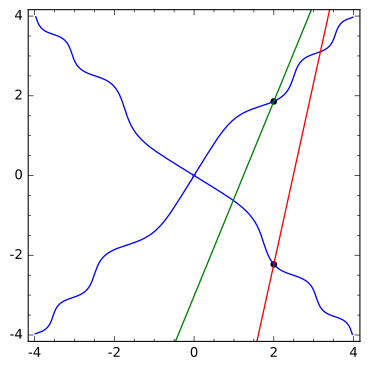
Create the implicit plot of the equation, , using -4 and 4 as your vertical and horizontal bounds. Then determine an x-y(x) expression for . Use it to find the slope(s) of any tangents to any point on the curve where . Create expressions for these tangent lines and plot curve, points and tangent lines on one plot.
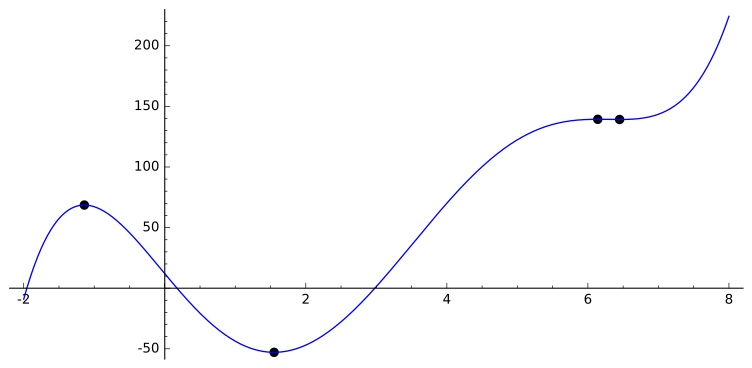
Given the quintic function, , first plot it with xmin=-2 and xmax=8. Then find its first derivative. Then find any and all zeroes of its first derivative. These will be the -coordinates of all the points where the tangent is horizontal(why?). Create the ordered pairs that result in using these first derivative zeroes as the x-coordinates and add these zero-slope tangent points to the plot in black. Now do the same thing with the function's second derivative, plotting any locations of second derivative zeroes in red. We will be calling these inflection points later on.
The formula for the surface area of a cylinder is . Declare and to be functions of , then define as a function of . Find the derivative of .
Consider and . Find all x-values for which the two functions' derivatives are of equal value.