
Companion to "Pfaffian Point Processes for Two Classes of Random Plane Partitions"
Demonstration of tsscpp_probabilities.sage
The following worksheet demonstrates some of the main features oftsscpp_probabilities.sage, which contains the following functions for computing probabilities associated with the TSSCPP point process:
rho(S, K, data_type)computes , whereKis either the matrix of interpolated entries of (in which case one setsdata_type = 's', symbolic) or the limiting kernel (data_type = 'n', numeric)rho_generalized(S, T, K, data_type)computesfirst_k_vert(k, K, data_type)computes or its limit , depending on whetherKis gives the interpolated matrix orfirst_k_hor(k, K, data_type)computes or its limitprob_dist_path_k(k, K, data_type)computes the probability distribution of the endpoint of path ; i.e., or its limit as
1. Loading the Interpolated Matrix and its Limit
We first load the matrices K_interpolated and K_infinity computed in the worksheet demo_tsscpp_interpolation.sagews.
2. Computing Horizontal and Vertical Probabilities and
Below, we demonstrate first_k_vert and first_k_hor for both the interpolated matrix and for .
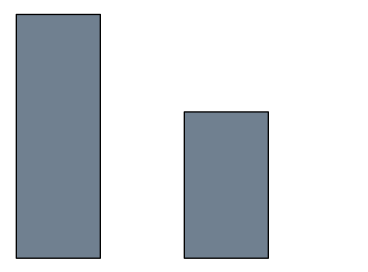
4. Computing the Limiting Distribution of Path
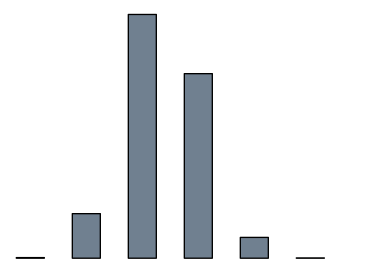
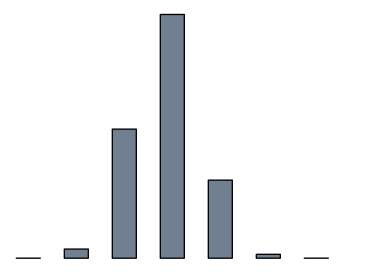
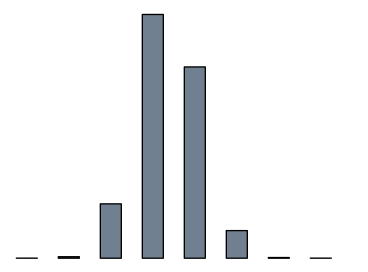
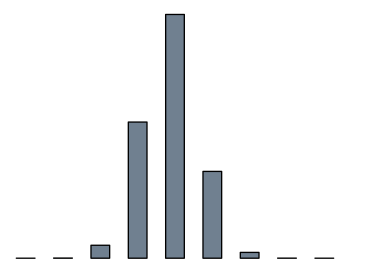
Below, we use prob_dist_path_k to compute the distribution of the endpoint of path (which has support on ) in the limiting TSSCPP point process given by kernel . One may compute individual path probabilities using the function prob_path_k_hits_x(k, x, K, data_type).
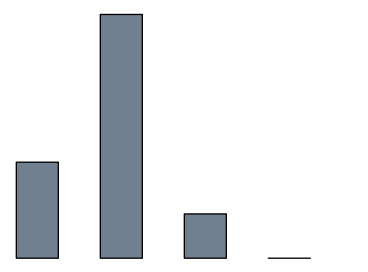
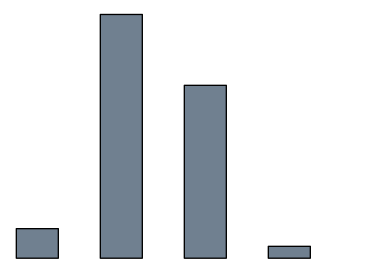
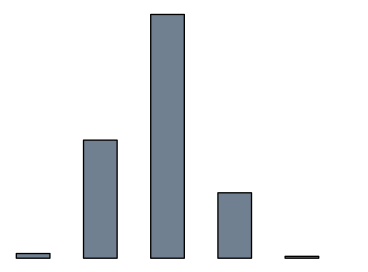
5. Computing (Symbolically) the Distributions of the First Few Paths
Now we use prob_dist_path_k to compute the distribution of the endpoint of path in the order- TSSCPP point process, using the interpolated kernel K_interpolated.